
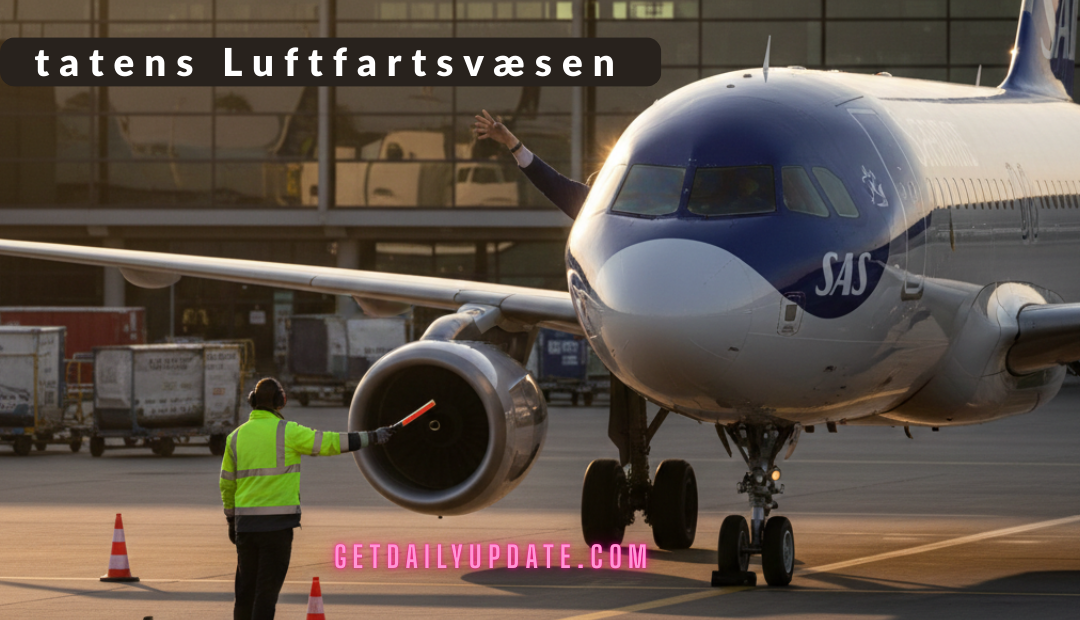
Have you ever been on a flight to Copenhagen, looked out the window at the wind turbines spinning in the Øresund Strait, and wondered, “How does all this air traffic actually work without chaos?”
I know I have. It’s easy to take for granted that our planes just… go where they’re supposed to. But behind every smooth takeoff from Billund and every safe landing on the island of Bornholm, there is a massive team of people working behind the scenes.
In Denmark, the organization responsible for this invisible magic trick is Statens Luftfartsvæsen (SLV). While the name might be a mouthful for non-Danish speakers (try saying it three times fast), their role is simple: keeping the skies safe.
If you are a frequent flyer, a private pilot, or just someone who lives near a flight path, understanding how this works is pretty fascinating. Let’s break down how this agency keeps everything running smoothly, safely, and on time.
![alt: Statens Luftfartsvæsen air traffic control tower guiding a plane at Copenhagen Airport]
Caption: The nerve center of Danish aviation.
What Exactly is Statens Luftfartsvæsen?
Let’s start with the basics. Statens Luftfartsvæsen, often abbreviated as SLV, is Denmark’s civil aviation authority. Think of them as the air traffic managers and rule enforcers for the entire country.
In the past, they were responsible for a lot of the practical stuff, like running the air traffic control systems. However, over the years, Denmark has restructured things to be more efficient. Today, while the name is still widely used historically, the regulatory side is handled by the Danish Transport, Construction and Housing Authority (Trafik-, Bygge- og Boligstyrelsen).
But regardless of the name on the door, the mission remains the same:
-
Safety: Making sure every flight meets strict standards.
-
Organization: Ensuring the airspace is used efficiently.
-
Regulation: Licensing pilots and approving maintenance schedules.
It’s the reason you don’t have to worry about a Cessna accidentally crossing paths with an Airbus on its way to New York.
The Three Pillars of Safe Skies
When I started looking into how countries manage their airspace, I realized it’s not just about radar screens. It’s about three distinct layers working together. Here is how SLV (and its modern counterparts) handles them.
1. Rulemaking and Regulation (The “Rulebook”)
Someone has to write the rules. In Danish aviation, the state authority sets the standards.
They translate international regulations from bodies like the European Union Aviation Safety Agency (EASA) into local Danish law. This covers everything from how often a commercial pilot must train in a flight simulator to what kind of fire extinguishers must be on board.
I remember speaking to a private pilot once who told me, “Flying in Denmark is so relaxed because the rules are strict.” It sounds contradictory, but it’s true. When the regulations are clear and enforced, everyone knows where they stand.
2. Air Traffic Control and Management (The “Execution”)
This is the part we usually picture: the men and women in the control towers.
While the actual air navigation service in Denmark is now provided by Naviair (a separate state-owned company), the oversight falls under the umbrella of what was historically SLV. They ensure that the air traffic controllers are qualified and that the technology they use is up to date.
From the moment a plane pushes back from the gate at Kastrup to the moment it cruises over the North Sea, someone is watching it. They are organizing the aircraft like a well-choreographed ballet, keeping them separated by specific distances to avoid turbulence and collisions.
3. Personnel and Aircraft Approval (The “Licensing”)
You can’t just wake up one day and decide to fly a Boeing 737 over Zealand. You need a license. And that license needs to be issued and validated.
The Danish aviation authority handles:
-
Pilot Licenses: Verifying training and medical fitness.
-
Maintenance Approvals: Certifying that the mechanics fixing the planes know what they are doing.
-
Airworthiness Certificates: Ensuring the aircraft itself is fit to fly.
Without this layer, the system would fall apart. It’s the quality control checkpoint that makes sure everyone in the system is qualified.
![alt: Statens Luftfartsvæsen official reviewing a pilot’s license and documentation at an airport office]
Caption: Behind every pilot is a regulator making sure the paperwork is perfect.
How Technology is Changing Danish Airspace
If there is one thing I’ve learned about aviation, it’s that it never stands still. The days of simply looking out of a tower window with binoculars are long gone.
Denmark is actually a pretty tricky place to manage air traffic. You have major international hubs, military operations with the Royal Danish Air Force, and a ton of small general aviation traffic flying to islands like Ærø and Læsø.
To handle this mix, the authorities rely on:
-
Digital Flight Plans: Everything is logged and tracked digitally before a plane even starts its engine.
-
Advanced Radar Fusion: Combining data from multiple radar sources to get a single, clear picture of the sky.
-
Drone Integration: This is the big new challenge. With so many drones buzzing around, the state has to create rules and systems to integrate them safely without hindering commercial traffic.
In my opinion, the drone integration is the most interesting part. It’s a wild west up there right now, and it’s up to the authorities to civilize it.
The Human Element: Why It’s More Than Just Machines
We live in a digital age where we trust algorithms for everything. But when I think about flight safety, I always come back to the humans.
I once had a flight delay leaving Copenhagen because of a “technical issue.” Most passengers were annoyed, but I was actually kind of grateful. What happened was a sharp-eyed maintenance engineer (licensed by the authority) spotted a tiny irregularity during a walk-around. The plane wasn’t going anywhere until it was fixed.
Statens Luftfartsvæsen fosters a culture where safety comes before schedules. This is huge.
In many industries, there is pressure to cut corners. “It’s probably fine.” But in Danish aviation, the “just culture” encourages people to report mistakes or issues without fear of punishment (unless it’s reckless). This means small problems get fixed before they become big emergencies.
That personal insight sticks with me: safety isn’t a switch you flip; it’s a culture you build.
Practical Tips for Staying Informed (As a Passenger or Pilot)
Whether you are a passenger who loves aviation or a student pilot just starting out, you can tap into the system that keeps the skies organized. Here are a few actionable ways to stay in the loop:
-
Check NOTAMs (Notices to Air Missions): Before any flight in Denmark, pilots check these. They are real-time updates about closed runways, military exercises, or GPS interference. You can find them online if you’re curious about what’s happening in real-time.
-
Use the Naviair App: If you are in Denmark and see a low-flying helicopter or plane, you can sometimes use apps to see what it is. It helps you understand that it’s not an emergency—it’s likely a police helicopter or an air ambulance, which are also coordinated within the system.
-
Visit a Control Tower (Open House): Copenhagen Airport and several other Danish airfields occasionally have open houses or events like “Airport Day.” It’s a fantastic way to see the coordination up close.
The Future: What’s Next for Danish Aviation?
Looking forward, the role of the aviation authority is only going to get more complex. We are looking at:
-
Green Aviation: Electric planes are coming. The authorities will need to figure out how to certify them and build the charging infrastructure at airports.
-
Supersonic Travel: New companies are trying to bring back supersonic jets. This changes everything about airspace organization.
-
Unmanned Traffic Management (UTM): Managing thousands of delivery drones simultaneously.
Statens Luftfartsvæsen (and its modern counterparts) will be the ones writing the playbook for all of this. It’s an exciting time, even if most people won’t notice the work happening behind the curtain.
![alt: A small general aviation aircraft flying over the Danish countryside near wind turbines]
Caption: Even small recreational flights are tightly integrated into the organized airspace.
Conclusion: Trust the System
The next time you buckle your seatbelt and feel the engines spool up for takeoff, I hope you take a second to appreciate the invisible network holding it all together.
From the strict regulations on maintenance to the highly trained air traffic controllers guiding the pilot, Statens Luftfartsvæsen is the reason Danish skies remain some of the safest and most organized in the world.
It’s a complex job, but someone has to do it—and thankfully, they do it very well.
Have you ever had a moment where you appreciated good air traffic control or strict safety regulations? Maybe a smooth landing in a storm, or a delay that actually made sense? I’d love to hear your stories in the comments below. Share this post with another aviation geek if you found it helpful!





Leave a Reply