
You know how sometimes life throws you into a role you never asked for—but spent your whole life secretly preparing for?
That’s kind of what’s happening right now in Iran.
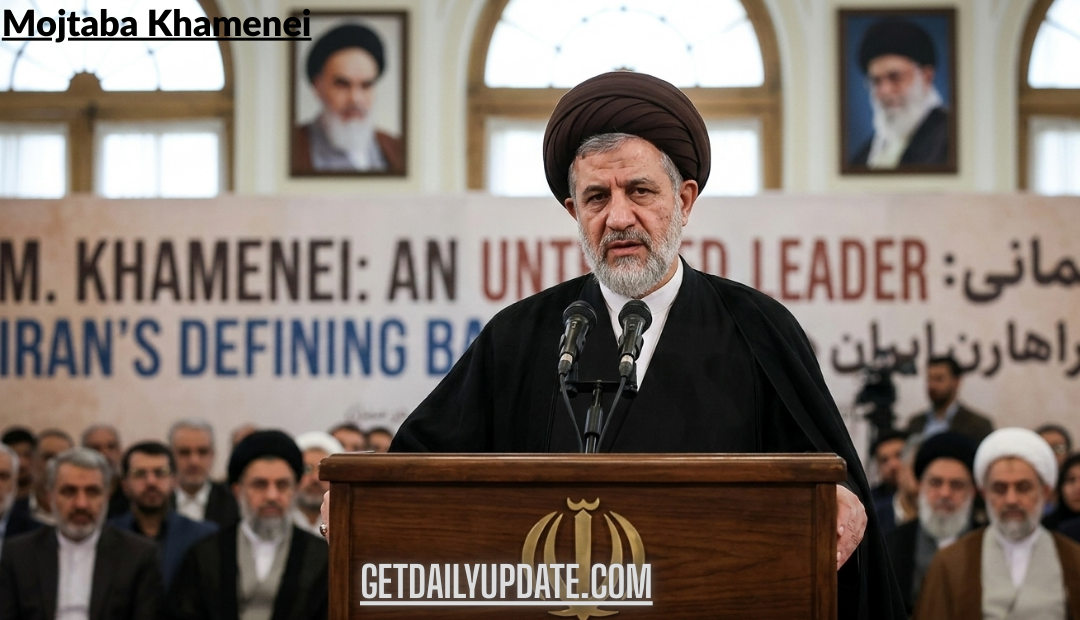
I’ve been following Middle East politics for years (it’s a habit I picked up during my college days studying international relations), and I have to be honest—I never thought I’d be writing about this particular scenario. Two weeks ago, the unthinkable happened. A U.S.-Israeli strike killed Iran’s longtime Supreme Leader, Ayatollah Ali Khamenei . And now? His son, Mojtaba Khamenei, has been named the country’s new leader .
Talk about a family business.
But here’s what’s keeping me up at night—and what I want to talk with you about today. Mojtaba is largely untested. He’s never held formal office. And he’s stepping into power during what experts are calling Iran’s “defining battle” with the West . So who is this guy? And what happens when someone with everything to prove—and a personal score to settle—takes the wheel?
Let’s dig in together.
Who Actually Is Mojtaba Khamenei?
Let me paint you a picture.
Mojtaba was born in 1969 in the holy city of Mashhad . He’s 56 now. If you saw him on the street, you’d probably notice the black turban first—that’s a big deal, by the way. It means his family claims descent from the Prophet Muhammad .
He joined the Islamic Revolutionary Guard Corps (IRGC) during the Iran-Iraq war in the 1980s . So he’s no stranger to conflict. After that, he studied theology in Qom, Iran’s center of religious learning .
But here’s where it gets interesting.
The “Gatekeeper” Years
For years, insiders called Mojtaba his father’s “gatekeeper” . He never held an official government position—like, never—but he had his hands in everything .
Think of him as the guy backstage running the soundboard while the lead singer takes all the glory.
The U.S. Treasury sanctioned him way back in 2019. Their statement said he was basically acting as Supreme Leader even then, working closely with IRGC commanders and militias .
A Hardline Reputation
Here’s what experts agree on: Mojtaba is more hardline than his dad .
Alan Eyre, a former U.S. diplomat, put it bluntly: “He’s going to have a lot of revenge to exact” . His parents were both killed in that strike . So we’re not just talking politics here—we’re talking personal.
I remember reading once that the most dangerous situations in international affairs happen when personal grievance and national policy get tangled up. That’s exactly what we’re seeing.
The Big Problem: Why “Untested” Matters
Okay, so here’s where I want to get real with you for a second.
I’ve worked with first-time leaders before—not at this level, obviously, but in smaller organizations. And let me tell you something I’ve learned the hard way: There’s a massive difference between being involved in decisions and actually making them.
Mojtaba has spent decades around power. But he’s never held a formal position . He’s never had to stand at the podium and take the final call when things go wrong.
What the Experts Are Saying
Vali Nasr, who studies Iran at Johns Hopkins, said Mojtaba’s appointment is about “continuity” . He’s more ready than other candidates to grab control quickly.
But “continuity” during peacetime is one thing. Continuity during an active war with the U.S. and Israel? That’s a whole different animal.
Paul Salem from the Middle East Institute said something that stuck with me: “Nobody emerging now is going to be able to compromise. This is a hardline choice, made in a hardline moment” .
Translation? This guy’s hands are tied before he even starts.
What Mojtaba’s Leadership Could Look Like
Let me share three possible paths I’m watching. (And full disclosure—these are educated guesses based on what experts are saying. Nobody has a crystal ball.)
Path 1: “Defiant Consolidation”
Patrick Clawson from the Washington Institute uses this term . It means:
-
Doubling down on IRGC support
-
Expanding missile strikes
-
Accelerating the nuclear program
-
Keeping regional proxies like the Houthis active
The goal? Get nukes fast enough that the U.S. and Israel think twice about another strike .
Path 2: The IRGC Really Takes Over
Here’s something the BBC pointed out that gave me chills: The strike didn’t just kill the Supreme Leader. It took out a bunch of top IRGC commanders too .
If Mojtaba ends up weak—and let’s face it, he’s starting from behind—the IRGC might just run things from the shadows . He’d be the face. They’d be the muscle.
Path 3: Total Chaos
This is the scary one.
If the IRGC fractures? If rival factions start fighting each other? You could end up with something like Libya—central authority collapsing, internal conflict taking over .
I honestly hope it doesn’t come to that. The Iranian people have been through enough.
How the World Is Reacting
You won’t believe some of the quotes I found researching this.
Donald Trump told ABC News that Iran’s new leader “is not going to last long” without U.S. approval . He actually said he needs to be “personally involved” in picking Iran’s next leader .
Israel warned that whoever took over would be “a target for elimination” .
Meanwhile, Russia’s Putin sent congratulations . China said it’s an internal Iranian matter .
It’s like watching two completely different movies playing at once.
What This Means for Regular People
I try never to write about geopolitics without remembering that real human lives are involved.
The Iranian people are caught in the middle. Some celebrated when the strike happened—you can find videos online of scattered celebrations . But many are just scared. Scared of more war. Scared of economic collapse. Scared of what comes next.
A friend of mine who grew up in Tehran once told me: “Americans think we all hate our government. Some do. Some don’t. But all of us hate being told what to do by outsiders.”
That’s worth remembering as we watch this unfold.
Practical Takeaways: How to Stay Informed
If you’re like me and you want to follow this story without losing your mind, here’s my advice:
-
Read multiple sources. Don’t just stick to one outlet. I check BBC, Reuters, and sometimes Xinhua for different angles .
-
Watch for nuclear announcements. That’s the big flashing red light. If Iran speeds toward a bomb, things escalate fast.
-
Pay attention to protests. The regime is vulnerable right now. Mass demonstrations could change everything .
-
Ignore the 24-hour news panic. Headlines are designed to grab attention. Take a breath. Read analysis, not just alerts.
My Take (The Human Part)
I’m going to be straight with you.
When I started writing this post, I thought I’d end with some neat conclusion about what happens next. But I can’t. This situation is too messy.
What I can tell you is this: Mojtaba Khamenei is stepping onto the world stage at the worst possible time—for him, for Iran, and for the region. He’s grieving. He’s angry. He’s untested. And he’s holding the reins of a country with nuclear ambitions, a powerful military, and a population that’s deeply divided.
I’ve been wrong about Middle East predictions before. (Ask me about the time I thought the Yemen ceasefire would actually hold in 2022—embarrassing.) So I won’t pretend to know the ending.
But I’ll be watching. And I hope you’ll watch with me—critically, carefully, and with compassion for the ordinary people caught in the middle.
Let’s Keep the Conversation Going
What do you think happens next? I’d genuinely love to know.
Drop a comment below if you’re following this story. Do you think Mojtaba can hold onto power? Will the IRGC call the shots behind the scenes? Or are we looking at the beginning of the end for the Islamic Republic?
If you want to read more information, visit.





Leave a Reply