
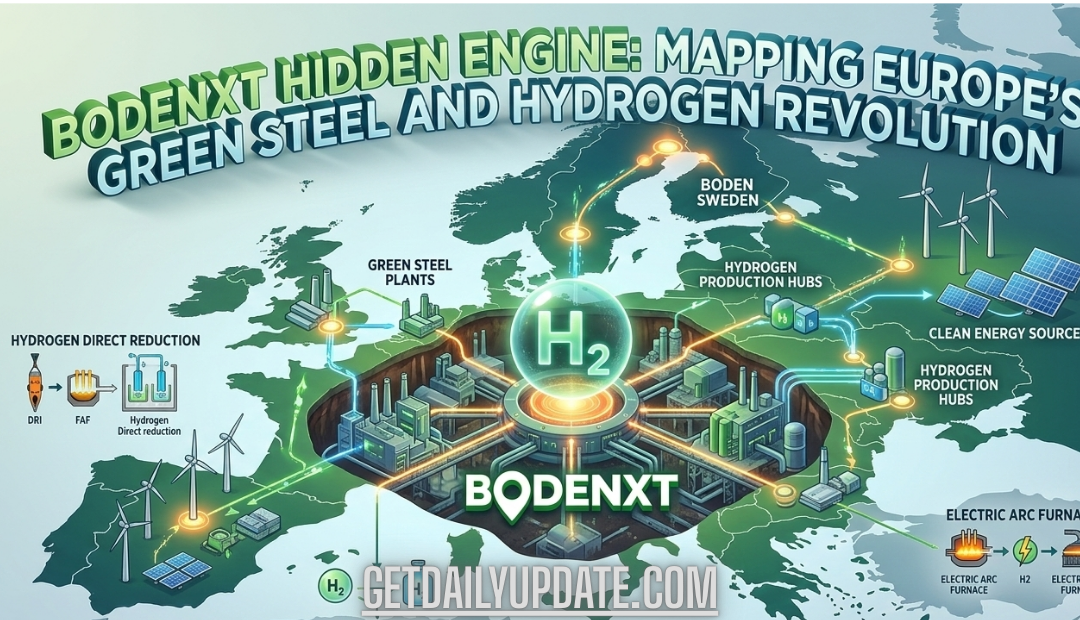
I’ll be honest with you: until a few months ago, I couldn’t have pointed to Boden, Sweden, on a map. I knew Northern Europe was doing cool stuff with wind and hydro power, but I didn’t realize it was home to what might be the most important industrial experiment of the decade.
Then I fell down a rabbit hole researching green steel, and I kept seeing the same name pop up: BodenXT. At first, I thought it was just another corporate buzzword for a factory upgrade. But the more I dug in, the more I realized this isn’t just a factory. It’s a blueprint. Today, I want to walk you through what I learned about the BodenXT hidden engine and how it’s quietly mapping the future of Europe’s green steel and hydrogen revolution. If you care about climate change or just want to know where your next car might come from, stick with me.
What Exactly is the BodenXT Hidden Engine?
So, what is this thing? It’s easy to glaze over when you hear “municipal transformation platform,” but BodenXT is basically the ultimate city planning upgrade on steroids .
Imagine your town suddenly got word that billions of euros were coming in, thousands of workers were moving in, and massive factories were being built. Most places panic. They get traffic jams, housing shortages, and chaotic sprawl. BodenXT is the opposite of that.
It’s a coordinated strategy by the municipality of Boden to manage explosive green industrial growth without losing its soul . Instead of just reacting to companies like Stegra (formerly H2 Green Steel) showing up, the city got ahead of it. They planned the housing, the schools, the fiber optics, and the train tracks before the cranes arrived . It’s a “hidden engine” because the average person doesn’t see the planning—they just see the result: a city that actually works.
Green Steel: Not Just a Dream Anymore
Let’s talk about the star of the show: steel. Did you know that steel production is responsible for roughly 7-8% of all global CO₂ emissions? . It’s one of those “dirty” secrets of modern life. Every bridge, skyscraper, and car starts with a blast furnace burning coal.
The facility inside the Boden Industrial Park—run by Stegra—is flipping that script. They’re using the BodenXT hidden engine to power a massive shift to hydrogen-based production .
How Hydrogen Changes the Game
Instead of coal, they use green hydrogen (made with renewable electricity) to strip oxygen from iron ore. The waste product here isn’t CO₂; it’s water vapor . The numbers are staggering:
-
Production Target: ~5 million tonnes of green steel annually .
-
Emission Reduction: Up to 95% lower CO₂ compared to traditional methods .
-
Jobs: Roughly 2,000 direct jobs by 2030 .
This isn’t a lab experiment. This is heavy industry being rebuilt from the ground up.
The Reality Check: It’s Not All Smooth Sailing
Now, I have to pause here and give you my honest take. When I first read about BodenXT, I was ready to book a flight to Sweden and join the fan club. But I’m also a realist. The more I read industry news, the more I realized we have to pump the brakes on the hype just a little.
While Boden is moving forward, the wider European green steel revolution is hitting some serious speed bumps .
Why Some Projects Are Stalling
I came across reports that made my coffee taste bitter. Major players like ArcelorMittal have delayed or canceled flagship green steel projects in Germany and France . Why? A few reasons:
-
Energy Costs: European energy prices are still sky-high compared to places like the US or Middle East. Making green hydrogen requires massive amounts of electricity, and if that juice is expensive, the steel becomes unaffordable .
-
Hydrogen Availability: This is a big one. We talk about green hydrogen like it’s flowing from a tap. It’s not. One executive flat out said, “We don’t really have hydrogen available—at least not in the scale needed” .
-
The Cost Premium: Green steel is expected to cost about a third more than conventional steel . Will we pay that? Maybe. But it’s a tough sell in a shaky economy.
This doesn’t mean Boden is a failure. It actually makes Boden more important. If they can make this work despite the headwinds, they prove it’s possible.
What BodenXT Gets Right (That Others Miss)
So, why is Boden succeeding where others are stalling? I think it comes down to that “hidden engine” philosophy I mentioned earlier. They aren’t just building a steel plant; they are building an ecosystem .
Here’s a quick snapshot of the five pillars they use to keep everything balanced :
-
Skills Supply: They’re training locals and attracting global talent so the factories actually have people to work in them.
-
Living & Housing: Building energy-efficient homes now so workers aren’t sleeping in tents later.
-
Business Development: Encouraging smaller supplier companies to set up shop nearby.
-
Above-Ground Infrastructure: Rails, roads, and 5G networks.
-
Below-Ground Infrastructure: Water, power lines, and utilities so they don’t have to dig up the roads next year.
That last point is so boring but so genius. They planned the pipes and cables before they paved the streets. It saves millions in the long run.
Actionable Steps: How to Track the Revolution
If you’re an investor, a student, or just a curious nerd like me, you might be wondering how to keep tabs on this without moving to Sweden. Here are a few practical tips I’ve picked up:
-
Follow the EU Funding: Keep an eye on the Clean Hydrogen Partnership. They just opened a €105 million call for proposals in 2026 to fund hydrogen valleys just like this one . If money is flowing there, the sector is growing.
-
Watch the “Hydrogen Bank”: The EU’s Hydrogen Bank auctions are a good thermometer for the industry. The second auction saw grants signed for projects in Finland, Spain, and Norway . Notice a trend? The Nordics are dominating because they have cheap renewable power.
-
Look for “Scrap” Strategies: Not everyone is waiting for pure green hydrogen. Companies like voestalpine are using electric arc furnaces powered by green electricity and recycled scrap steel to cut emissions by 30% right now . It’s a bridge technology, but it’s happening today.
My Take: Why This Gives Me Hope
Look, reading about the delays and the economic hurdles can be depressing . There are valid arguments out there that the “green steel mirage” might cost us trillions with little return . I’m not an economist, so I can’t verify those global models.
But here’s what gives me a gut feeling of optimism: integration. The BodenXT model proves that we aren’t just throwing money at a machine; we are rethinking how industry lives alongside people. When I see a plan that includes both a 550-hectare industrial park and plans for schools and parks, I see a future that might actually work . It’s messy, it’s expensive, and it’s slow—but it’s happening. And for the first time in a long time, it feels like we’re building something rather than just tearing the old stuff down.
Conclusion: The Map is Being Drawn
The BodenXT hidden engine is more than a Swedish project; it’s a test case for the entire world. It asks the hard question: Can we have heavy industry and a livable planet? The answer isn’t certain yet. There are political risks, economic risks, and massive technical hurdles . But Boden is proving that with enough planning, community buy-in, and renewable energy, the “green steel revolution” has a fighting chance.
If you want to read more information, visit.




Leave a Reply