
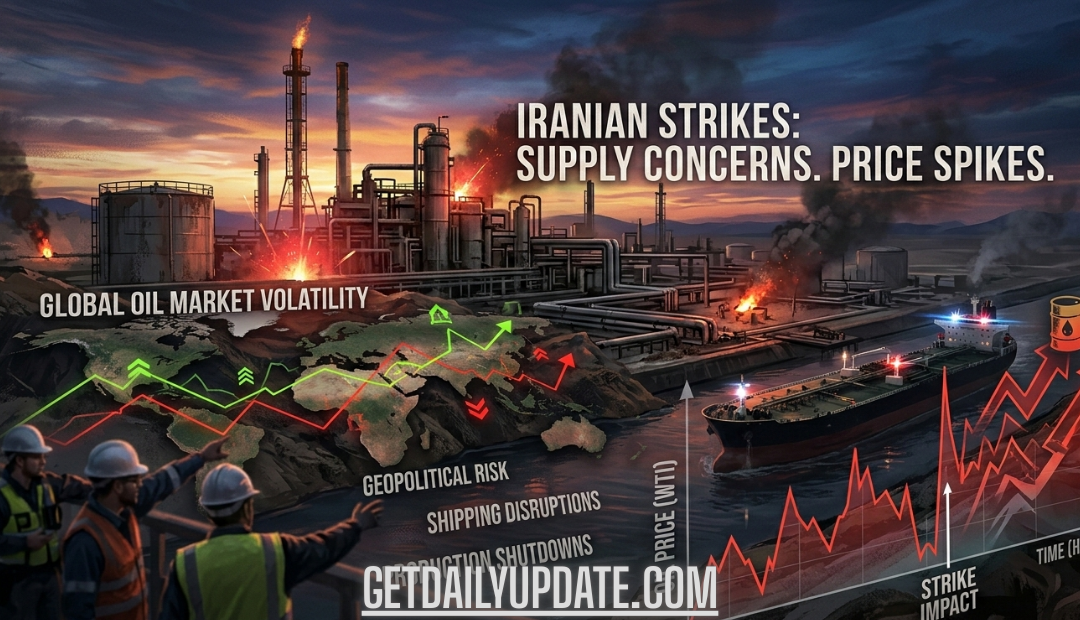
If you’ve filled up your gas tank recently or glanced at the news, you’ve probably noticed that things are feeling a little tense. I don’t know about you, but whenever I see headlines about military action in the Middle East, my first thought isn’t always about geopolitics—it’s about what I’m going to pay at the pump next week.
Right now, we’re watching a classic case of oil market volatility amid Iranian strikes. It’s a lot to wrap your head around, and honestly, it can be scary if you’re on a tight budget. One day prices are down, the next they’re spiking. It feels like riding a rollercoaster that only goes up when you don’t want it to.
So, what’s actually going on? Why does conflict in one part of the world make our wallets hurt everywhere else? Grab a coffee, and let’s break this down in plain English.
What Causes Oil Prices to Jump Overnight?
When you hear about military strikes, especially from a major player like Iran, the oil market doesn’t wait to see what happens. It reacts immediately. Think of the market like a very nervous friend who assumes the worst before they have all the facts.
The “Fear Factor” (Geopolitical Risk Premium)
Traders hate uncertainty. When missiles fly, there’s a fear that oil production or transport might stop. About 20% of the world’s oil passes through the Strait of Hormuz, a narrow waterway near Iran. If that route gets disrupted, even for a day, it creates chaos.
-
The Reaction: Traders bid up the price of futures contracts. They’re not buying physical barrels of oil yet; they’re betting that oil will be harder to get tomorrow.
-
The Result: The price of Brent Crude (the global benchmark) can jump $3, $5, or even $10 in a matter of hours purely on fear.
Supply Chain Jitters
It’s not just about the oil itself. It’s about getting it to refineries. When there’s conflict, shipping insurance rates go through the roof. Tanker captains might refuse to sail into dangerous waters. This creates a bottleneck, and bottlenecks mean higher costs for everyone.
My Personal Take: Watching the Ticker
I’ll be honest with you—I’m a bit of a nerd when it comes to tracking the markets. I remember one evening last week, I was cooking dinner and had Bloomberg on in the background (yes, I’m that guy). The second the first reports of the strikes hit the wire, I watched the oil ticker literally jump in real-time.
It’s fascinating, but also a little sickening. It’s a stark reminder that the global economy is connected by a very fragile thread. We go about our daily lives, but events thousands of miles away can dictate whether we can afford to drive to see our families on the weekend. It makes you realize how little control we actually have over the macro stuff, which is why it’s so important to control what we can at home.
How This Affects Your Daily Life (Beyond Gas Prices)
Okay, so we know gas prices go up. But the ripple effect of oil market volatility goes way deeper than just your trip to the pump.
-
Food Costs: This is a big one that people forget. Farming relies on diesel for tractors and combines. Food has to be shipped via trucks or planes (both fuel-dependent). When oil spikes, your grocery bill follows. That loaf of bread or carton of milk gets more expensive because it cost more to get it to the store.
-
Airfare: Airlines operate on razor-thin margins. Jet fuel is their biggest expense. If oil prices stay high for weeks, you can almost guarantee that airlines will slap on surcharges or raise ticket prices.
-
Investments: If you have a 401k or any investments in the stock market, energy volatility can spook the whole market. High oil prices can lead to inflation, which makes the Federal Reserve nervous, which can lead to interest rate hikes. It’s a big, messy domino effect.
What History Tells Us About Oil and Conflict
This isn’t the first time we’ve been here. If you look back at the history of oil shocks—from the 1973 oil embargo to the Gulf War—the pattern is usually the same.
-
Immediate Spike: Panic buying drives prices up fast.
-
The Wait: The market holds its breath to see if the conflict spreads to other countries (like Saudi Arabia or Iraq).
-
The Calm (or Correction): If the conflict stays contained and supply lines aren’t actually hit, prices usually settle down a bit after a week or two.
The big question this time is: Will Iran target energy infrastructure? If they hit undersea cables, pipelines, or tankers, we’re looking at a longer, more sustained period of high prices. If it stays as a “limited” exchange, we might see volatility cool off.
Practical Tips: How to Protect Your Budget Right Now
So, what can we actually do about it? We can’t control Iran, and we can’t control OPEC. But we can be smart about our own habits. Here are a few things I’m doing right now to hedge against the chaos:
-
Don’t Panic at the Pump: When you hear bad news, it’s tempting to rush out and fill up every car and gas can you own. Don’t. That creates artificial demand and drives prices up even faster. Just buy what you need.
-
Use Gas Rewards Apps: Seriously, if you aren’t using an app like GasBuddy or your grocery store’s fuel points program, you’re leaving money on the table. I saved $0.40 a gallon last week just because I bought groceries.
-
Combine Errands: This sounds simple, but plan your driving. Instead of going out three separate times, do it all in one loop. You save gas, time, and stress.
-
Check Your Tire Pressure: Under-inflated tires kill your gas mileage. Properly inflated tires can improve your efficiency by up to 3%. Every little bit counts when prices are high.
The Road Ahead: What to Watch For
We’re not out of the woods yet. The oil market is going to stay jumpy until there’s a clear resolution. I’ll be watching the diplomatic channels closely. If major powers step in to de-escalate, we’ll likely see prices retreat.
For more deep dives on how global events shape the economy, check out my post on [Understanding Supply and Demand Shocks (Internal Link)] or [5 Ways Geopolitics Affects Your 401k (Internal Link)]. For real-time data, I always trust the U.S. Energy Information Administration (EIA) for accurate stats.
It’s a stressful time, but knowledge is power. The more we understand why prices are moving, the less scary it feels.
Conclusion
Look, oil market volatility amid Iranian strikes is a textbook example of how fragile our global systems can be. Prices are spiking because of fear, uncertainty, and the very real risk of supply disruption. While we can’t stop the news from happening, we can stop it from ruining our personal finances.
If you want to read more information, visit.




Leave a Reply