
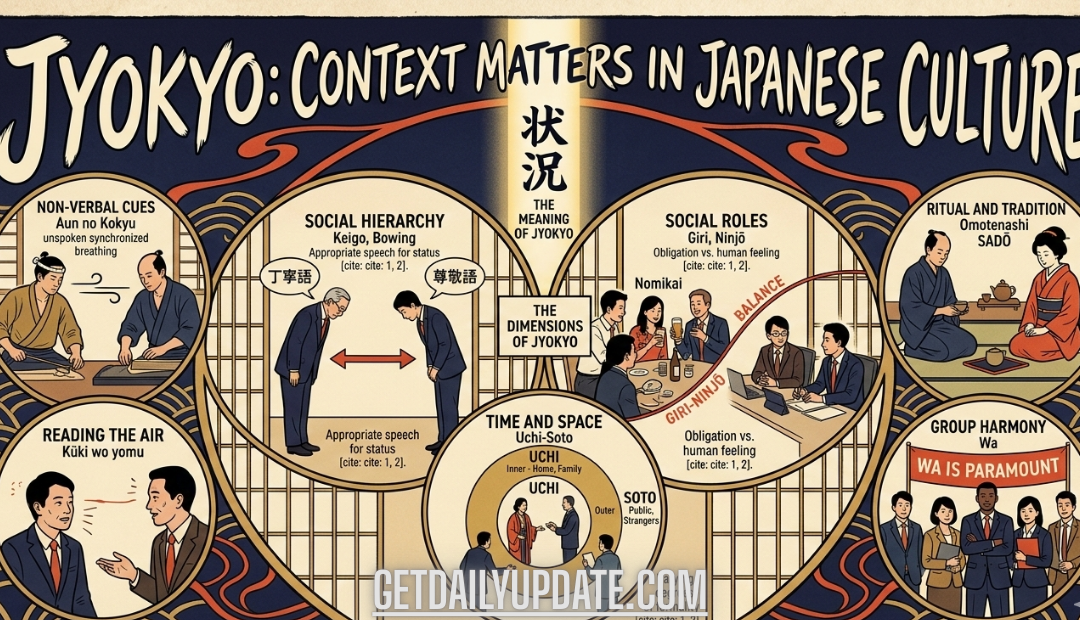
Have you ever said something perfectly translated, only to be met with a confusing smile in return? Or watched a Japanese colleague make a decision that seemed to come out of left field, wondering what you missed?
I remember my first few months navigating life in Tokyo. I knew the words, but I constantly felt like I was showing up to a party an hour late. Everyone else seemed to be in on a joke I wasn’t. That’s when a friend gently explained that in Japan, what you say is often less important than when you say it, where you say it, and who you are saying it to.
That missing piece of the puzzle is what we’re diving into today. We’re going to explore the concept of jyokyo . It’s a word that simply translates to “situation” or “context,” but in the Japanese mindset, it represents a whole way of life. If you’ve ever wanted to truly connect with Japanese culture or improve your communication, understanding jyokyo isn’t just helpful—it’s essential.
What is Jyokyo? More Than Just a Situation
Let’s start with the basics. In the simplest terms, jyokyo means “the current situation” or “the state of affairs” .
If you look at the kanji (Chinese characters) that make up the word, it tells a deeper story:
-
Jō: This character implies a “form,” “condition,” or “state.”
-
Kyō: This character refers to the “circumstances” or “surroundings.”
Put them together, and you get a beautiful definition: the condition of your surroundings . It’s not just about the cold, hard facts of a moment. It’s about the mood of the room, the relationship between the people in it, and the unspoken rules that apply right now.
In Western cultures, we often communicate in a “low-context” way. We tend to say what we mean directly. The words themselves carry most of the message. However, Japan is famously a “high-context” culture . This means that the message is heavily implied by the jyokyo—the context.
The Heart of the Matter: “Reading the Air” (Kuuki o Yomu)
You can’t talk about jyokyo without talking about the famous Japanese phrase (kuuki o yomu) , which literally means “to read the air” .
This is the action that the concept of jyokyo demands. If jyokyo is the situation, then “reading the air” is the skill of sensing it.
I’ll never forget the first time I truly saw this in action. I was in a quiet meeting, and a senior manager complimented a younger employee on his new watch. The younger guy lit up and spent a full minute explaining the features and where he bought it.
The room went silent. Why? Because he failed to read the jyokyo. The manager wasn’t actually interested in the watch. He was subtly pointing out that the meeting was running long and it was time to wrap up . By missing the cue, the younger employee appeared self-absorbed and oblivious. He was labeled, at least temporarily, as KY (kuuki ga yomenai) —someone who “can’t read the air.” It’s a tough label to shake.
Real-World Examples of Context at Play
We interact with high-context communication every day, often without even realizing it. Here are a few ways jyokyo dictates daily life:
-
The Power of “Chotto”: The word chotto means “a little.” But if a friend asks you to go to a movie and you respond with “Chotto…” while looking down, you haven’t said “no.” But you have. The jyokyo (your hesitation, your tone, your avoidance of eye contact) tells them the answer is no without you having to utter a direct rejection .
-
Saying “Sorry” to Say “Thank You”: This one tripped me up for years. When someone picks up something you dropped, the correct response isn’t always Arigato (thank you). Often, it’s Sumimasen (excuse me/I’m sorry). Why? Because the jyokyo implies that your mistake caused them trouble. You are acknowledging the inconvenience to them, which is a form of deep gratitude in Japanese culture .
-
The Silent Treatment on the Train: If someone falls or is doing something slightly odd (like standing on the wrong side of the escalator), people will often practice miteminufuri—turning a blind eye . To an outsider, this looks cold. But reading the jyokyo reveals the intention: they are pretending not to notice to save the person from embarrassment .
💡 Personal Insight
I used to think “reading the air” was just a fancy term for being intuitive. But after living there, I realized it’s a actively practiced skill. It forces you to be a better listener—not just to words, but to silences, postures, and micro-expressions. It’s actually exhausting at first, but once you get it, it makes you a more empathetic person everywhere, not just in Japan.
Jyokyo vs. Other Similar Words
To really lock in the meaning of jyokyo, it helps to compare it to other Japanese words that we might translate as “situation” in English. They aren’t interchangeable, and mixing them up can actually change what you’re trying to say.
Think of it this way: jyokyo refers to the dynamic, unfolding scene around you. It’s the active, changing circumstances—like “the current traffic situation” or the mood in a meeting room that shifts when the boss walks in. It asks the question, “What is happening right now?”
Then you have joutai, which is more about a fixed or physical condition. If you’re talking about the state of your health or the condition of a used car you’re thinking of buying, this is your word. It’s static. It asks, “What is its current condition?”
Finally, there’s jijou. This one digs into the background. When someone explains their “family circumstances” or the reasons behind a complicated decision, they’re talking about jijou. It asks, “W hat is the backstory or personal reason here?”
Understanding the difference helps you see the nuance. If you use joutai when you should use jyokyo, you might sound like you’re describing a snapshot when everyone else is watching a movie. Getting these right is a small but powerful way to show you truly understand the context—the jyokyo—of the conversation itself.
How to Start “Reading” the Jyokyo (Practical Tips)
So, how do you get better at this if you didn’t grow up with it? The good news is that you can cultivate this skill. It’s like a muscle you need to exercise.
1. Listen to the Silence
In many cultures, silence is awkward and must be filled. In Japan, silence is a meaningful part of the conversation . It’s a space for reflection and consensus. If you ask a question and are met with silence, don’t repeat the question louder. Wait. The answer might be forming, or the silence is the answer.
2. Watch the Non-Verbals
Only about 30% of communication is verbal. Pay attention to micro-expressions, posture, and eye contact . Is your colleague giving a social smile that doesn’t reach their eyes? Are they shifting uncomfortably? These are all part of the jyokyo.
3. Consider the Hierarchy
Japan is a hierarchical society. The jyokyo always includes the relative social status of the people involved . The way you speak to a boss is different from a friend, and the boss is expected to speak differently, too. If you ignore this, you disrupt the harmony of the situation.
4. Ask “Why” Later
If you feel you’ve misread a situation, find a trusted friend to explain the subtext later. Ask, “When I said X, everyone got quiet. What was the feeling in the room?” This is the best way to learn the invisible rules.
Why This Matters to You (Even if You Never Visit Japan)
You might be thinking, “This is interesting, but I don’t plan on moving to Tokyo.” That’s fair. But the lesson of jyokyo is universal.
We all navigate complex social landscapes every day. At work, at home, with friends—every interaction has a context. By borrowing this Japanese concept, we can remind ourselves to pause and assess the full picture before we speak or act.
It teaches us patience, empathy, and situational awareness . It’s the difference between just hearing someone and actually understanding them. Whether you’re negotiating a deal or just trying to be a better friend, paying attention to the jyokyo—the mood, the history, the unspoken dynamics—will change how you connect with people.
Conclusion: The Big Picture
At the end of the day, jyokyo is a tiny word with a massive job. It represents the Japanese understanding that we don’t exist in a vacuum. Our words and actions are only meaningful in relation to the world around us.
It reminds us that good communication isn’t just about having the right vocabulary; it’s about having the right awareness. By striving to understand the jyokyo, we stop trying to just “be right” and start trying to “be appropriate,” “be kind,” and “be harmonious.”
So, the next time you find yourself in a confusing situation—whether in Japan or at your local coffee shop—take a breath. Look around. Read the air. You might be surprised by how much you’ve been missing.
Have you ever experienced a moment where context was everything? I’d love to hear your story in the comments below!





Leave a Reply