
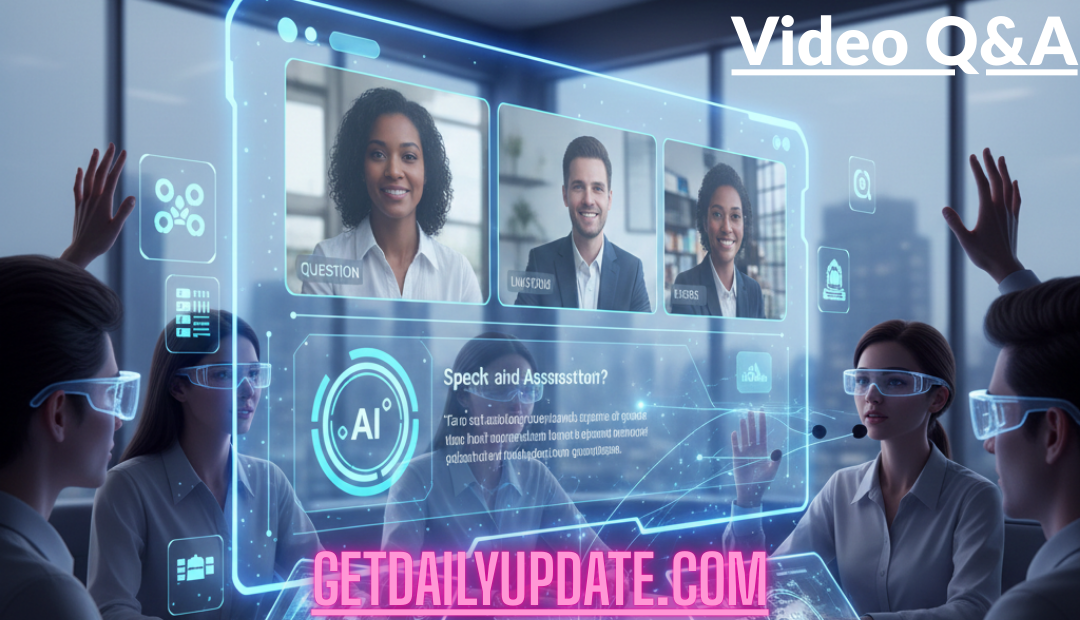
Have you ever sat through a pre-recorded webinar and wished you could raise your hand to ask a question right at that moment? Or watched a product demo and wanted to click on the screen to see a specific feature in action, rather than scrubbing through a timeline?
I have—more times than I can count. For the longest time, video has been a one-way street. We watch, we listen, but we don’t really interact. It’s been a passive experience in an active world. But that world is changing fast. We’re moving from simply watching videos to having conversations with them. Welcome to the era of the Interactive Video Q&A, where artificial intelligence is transforming audio-visual content from a lecture into a dialogue .
In this post, I’m going to walk you through what this actually looks like, why it matters for you and your business, and how you can start using it today. Trust me, once you see the potential, you won’t want to go back to static video again.
What is Interactive Video Q&A, Really?
Let’s break it down. When I say “Interactive Video Q&A,” I’m not just talking about a live Zoom call where people type questions into a chat box. That’s part of it, sure. But the real magic happens when you layer AI on top of video .
Think about it this way: traditional video calls connect people. AI-powered interactive video connects people with information in a dynamic way. Imagine a training video that pauses to ask you a question and, based on your answer, shows you a different module. Or a customer support clip where you can ask a question out loud, and an AI avatar hears you and provides the specific answer you need right there in the video .
It’s a shift from “lean back” to “lean in.” The video isn’t just playing; it’s listening, responding, and adapting to you in real-time. This is what makes the Interactive Video Q&A such a game-changer. It turns a monologue into a conversation.
Why This Shift is Happening Now
So, why is this trend exploding right now? Well, we’ve hit a perfect storm of technology and user demand.
First, our attention spans are shot. I’ll admit it, mine is. We’re used to TikTok and Instagram, where we swipe and tap constantly. Sitting through a 30-minute explainer video without any interaction feels almost painful now. We’re wired for engagement .
Second, AI has gotten scarily good. Natural language processing means AI can actually understand the intent behind your question, not just match keywords . And with tools becoming more accessible, you don’t need a team of Hollywood programmers to create this stuff anymore.
The data backs this up too. HubSpot found that interactive content, including video, offers one of the highest returns on investment for marketers . When people participate, they remember. They trust. They buy.
How AI is Powering Smarter Conversations
Let’s get into the “how” for a second. What does AI actually bring to the table in a video?
Real-Time Responsiveness
In the past, interactive videos were “branched” stories—you picked option A or B. AI makes it fluid. You can ask a spontaneous question, and the system can generate a response or pull the correct clip instantly. It’s like having a subject matter expert inside your screen, ready to answer “Wait, what does that mean?” at any moment .
Emotion and Sentiment Analysis
This is the cool part. Advanced AI can actually read the room—well, read you. It can analyze your tone of voice or even facial expressions (with permission) to gauge if you’re confused or engaged . If you look puzzled during a tutorial, the AI might suggest, “That was a tough concept. Would you like a simpler explanation?” That level of empathy is wild, but it’s happening now.
Personalized Pathways
Because the AI is learning from your interactions, it can tailor the journey. If you breeze through beginner questions, it speeds you up. If you’re struggling, it offers more help. It’s not the same video for everyone anymore.
Practical Ways to Use Interactive Video Q&A
I’m a big fan of actionable advice, so let’s look at where this actually works in the real world. The applications are broader than you might think.
Revolutionizing Online Learning (EdTech)
If you’re a teacher or a corporate trainer, this is your new best friend. We’ve all seen the stats about students zoning out during long video lectures . Interactive video fixes that.
Instead of just watching a history documentary, students can be asked to make decisions at key turning points. Instead of a passive safety briefing, employees have to click through scenarios to prove they understand the protocol. You can embed quizzes directly into the timeline of a video to check for understanding before the student can move on . It turns learning from a passive activity into a “lean forward” experience.
Supercharging Customer Support
I absolutely hate waiting on hold for customer service. But what if I could go to a company’s website, pull up an interactive video FAQ, and just talk to it? “Hey, I can’t find the Bluetooth pairing button.”
An AI avatar could appear and visually guide me through the steps, highlighting the exact button on my screen . It’s support that scales infinitely and never gets frustrated. Companies are already using AI avatars to moderate interviews and guide conversations, so doing this for support is a natural next step .
Marketing and Sales That Convert
Imagine you’re shopping for a new sofa online. You see a video ad. Instead of just watching it, you can click on the sofa in the video to see it in different colors, or ask, “Does this fit in a small apartment?” right there in the player. The video becomes a sales assistant .
This isn’t sci-fi. Brands are using interactive video to create “choose your own adventure” style ads that keep viewers engaged for minutes instead of seconds . That’s a lifetime in digital marketing.
My Take: It’s About Being Human
Here’s my personal honest opinion. With all this talk about AI and algorithms, you might think we’re moving toward a cold, robotic future. But I actually see it the opposite way.
For years, digital communication has been flat. We hide behind emails and texts because they’re safe. Interactive Video Q&A brings back the nuance of human conversation. It restores the ability to ask for clarification, to see empathy in a response (even if it’s from a well-designed avatar), and to connect on a deeper level .
The technology isn’t there to replace us; it’s there to make our digital interactions feel less digital. When done right, AI doesn’t make video feel more artificial—it makes it feel more human.
How to Get Started with Interactive Video
Feeling inspired? Good. You don’t need a Hollywood budget to dip your toes in here. Here’s a simple roadmap to get started:
-
Start Small with Live Tools: If you’re doing live webinars, start by integrating better Q&A tools. Platforms like Vevox or Slido allow you to run polls and take questions that appear on screen, making your live audience feel heard .
-
Identify Your Goal: Don’t just make a video interactive for the sake of it. Are you trying to educate? Sell? Support? Your goal will dictate the features you need.
-
Choose Your Platform:
-
For simple interactivity: Look at tools that add quizzes to existing videos, like those within Kaltura or other learning management systems .
-
For AI-driven avatars: Platforms like D-ID or Synthesia are leading the charge in creating AI presenters that can speak to your audience .
-
For choose-your-own-adventure style: Tools like Mindstamp or Wirewax let you add clickable hotspots and branches to standard video files .
-
-
Map the Journey: Write a script, but also draw a flow chart. What happens if the user says “Yes”? What happens if they say “No”? Planning the logic ahead of time saves a ton of headache.
-
Test and Tweak: Run it by a small group of real people. Watch where they click, where they get confused, and where they drop off. Use that data to make version 2 even better.
The Road Ahead
We’re still in the early days, but the direction is clear. The static, one-size-fits-all video is going to feel as outdated as a VHS tape pretty soon.
We’re heading toward a web that is fluid, conversational, and deeply personalized. Whether it’s a student mastering a tough subject, a customer fixing their own appliance, or a fan exploring a new product, the Interactive Video Q&A is the tool that makes it all possible.
It bridges the gap between the richness of face-to-face conversation and the scale of digital media. And honestly? I can’t wait to see what we build with it.
Let’s Keep the Conversation Going
What about you? Have you tried an interactive video recently, either as a viewer or a creator? I’d love to hear your thoughts. Drop a comment below and tell me about your experience—or share this post with a friend who’s tired of boring, one-way videos.
If you want to stay updated on the latest in AI and communication tech, subscribe to the newsletter. We promise no spam, just honest insights like this one.





Leave a Reply